The Slingshot that could kill the water shortage giant May 28, 2014
Posted by dvgibson in Uncategorized.add a comment

I read a great article in the current (June 2014) issue of Popular Science on Dean Kamen of DEKA R&D in Manchester, New Hampshire. The list of inventions he and his company have developed is very impressive, but I was even more impressed with they focus on making the world a better place. The Slingshot, which sprung from another project to create a better dialysis machine, one that could sit on a patient’s bed side table and work while they slept. But then he realized there was opportunity to use the water purifier which he created to make the dialysis machine practical to provide clean drinking water in developing countries, especially where disasters exacerbate the problem. And partnering with Coca-Cola to distribute it was genius.
Take a look at the Coca-Cola Ecocenter here:
http://www.coca-colacompany.com/stories/slingshot-how-it-works
And read more about Kamen at:
Zingerman’s 12 Natural Laws of Business May 26, 2014
Posted by dvgibson in Uncategorized.add a comment
At Newark Airport, the Lights Are On, and They’re Watching You – NYTimes.com May 9, 2014
Posted by dvgibson in Interesting.add a comment
On a flight back from Atlanta I read an article on Sensity Systems that makes smart LED lighting. Not only do they provide light, they monitor just about everything around them. Newark Airport now has them.
At Newark Airport, the Lights Are On, and They’re Watching You
By DIANE CARDWELL[1]FEB. 17, 2014
Photo 
This LED-based light fixture can gather and transmit data for automated analysis. Credit Peter DaSilva for The New York Times
Visitors to Terminal B at Newark Liberty International Airport[2] may notice the bright, clean lighting that now blankets the cavernous interior, courtesy of 171 recently installed LED fixtures. But they probably will not realize that the light fixtures are the backbone of a system that is watching them.
Using an array of sensors and eight video cameras around the terminal, the light fixtures are part of a new wireless network that collects and feeds data into software that can spot long lines, recognize license plates and even identify suspicious activity, sending alerts to the appropriate staff.
The project is still in its early stages, but executives with the Port Authority of New York and New Jersey[3], which operates the airport, are already talking about expanding it to other terminals and buildings.
To customers like the Port Authority, the systems hold the promise of better management of security as well as energy, traffic and people. But they also raise the specter of technology racing ahead of the ability to harness it, running risks of invading privacy and mismanaging information, privacy advocates say.
Photo 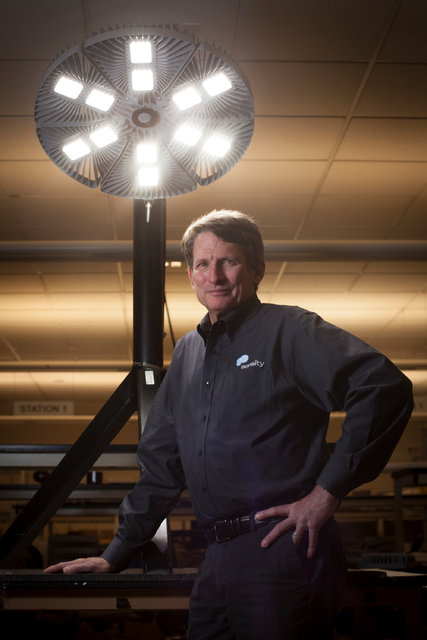
Hugh Martin, chief executive of Sensity Systems, says “there is a lot of value, I think, if we do it right, to this information.” Credit Peter DaSilva for The New York Times
Fred H. Cate, director of the Center for Applied Cybersecurity Research at Indiana University, described the potential for misuse as “terrifying.”
His concern derived not from the technology itself but from the process of adopting it, driven by, he said, “that combination of a gee-whiz technology and an event or an opportunity that makes it affordable.” As a result, he said, there was often not enough thought given to what data would actually be useful and how to properly manage it.
At Newark Airport, the Port Authority will own and maintain the data it collects. For now, it says, no other agencies have access to it, and a law enforcement agency can obtain it only through a subpoena or written request.
What began as a way to help governments and businesses save energy by automatically turning lights on and off has become an expanding market for lights, sensors and software capable of capturing and analyzing vast amounts of data about the habits of ordinary citizens.
The light fixtures are outfitted with special chips and connect to sensors, cameras and one another over a wireless network. Data that is collected — say, a particular car pulling up to the terminal — can then be mined and analyzed for a broad range of applications. Systems like the Port Authority’s, developed by a company called Sensity Systems[4], could soon be more widely available. Under a recent agreement, Amerlux[5], a leading lighting manufacturer, will start using the technology in its LED fixtures.
“We are opening up an entirely new area in lighting applications and services,” said Chuck Campagna, Amerlux’s chief executive, “including video-based security and public safety, parking management, predictive maintenance and more.”
Other companies, including giants like Cisco Systems and Philips, are racing to grab a share of that market.
Las Vegas is testing a street lighting system that can broadcast sound, and plans to use it mainly to control lighting and play music or to issue security alerts at a pedestrian mall.
Copenhagen is installing 20,000 streetlamps as part of a system that could eventually control traffic, monitor carbon dioxide levels and detect when garbage cans are full. Other government agencies and businesses have begun replacing thousands of lighting fixtures with LEDs, mainly to cut costs.
The trend is expected to accelerate as the fixtures become cheaper and more sophisticated. Navigant Consulting, a firm based in Chicago, has estimated that cities’ interest will prompt more than $100 billion in spending on the technology over the next 10 years.
“More and more what we’re seeing is decision-makers choosing networked lighting controls not just for the energy benefits but for a whole host of nonenergy benefits,” said Jesse Foote, a lighting industry analyst at Navigant.
Sensity’s technology, for example, would allow light fixtures and sensors to pinpoint a gunshot, sense an earthquake or dangerous gas, or spot a person stopping at various cars in a parking lot.
Photo 
An assembler at Sensity Systems works on one of the company’s sensor-equipped, wirelessly networked lighting fixtures. Credit Peter DaSilva for The New York Times
Some cities already have more targeted sensors, like the ShotSpotter gunshot location system in use by more than 70 American cities, including Boston, Milwaukee and San Francisco. But the Sensity network can bring them together through existing light fixtures.
The system could, once software is developed, also make shopping more convenient — a potential boon for malls losing business to the Internet. Sensing a shopper pulling into a parking lot, the system could send an alert to a smartphone, showing empty spaces, or a coupon.
“We see outdoor lighting as the perfect infrastructure to build a brand new network,” said Hugh Martin, Sensity’s chief executive. “We felt what you’d want to use this network for is to gather information about people and the planet.”
Continue reading the main story
Recent Comments
19 February 2014
Our country is coming more and more to resemble some lesser beast; a chimera of sorts – part UK, with their invasive and heavy-handed use of…
Chicago Guy
18 February 2014
As another commentator stated a few months ago, "If you not smuggling heroin, you shouldn’t mind the cavity search…"Orwellian logic at…
Sancho
18 February 2014
One more sign that we’re becoming a surveillance state, bit by bit, a grotesque situation to which habit will accustom us, just as it…
- See All Comments
But that is precisely what worries privacy advocates.
“There are some people in the commercial space who say, ‘Oh, big data — well, let’s collect everything, keep it around forever, we’ll pay for somebody to think about security later,’ ” said Justin Brookman, who studies consumer privacy at the Center for Democracy and Technology. “The question is whether we want to have some sort of policy framework in place to limit that.”
Even those developing the technology acknowledge the concerns.
“I’m not saying that I know the exact balance point, but there is a lot of value, I think, if we do it right, to this information,” Mr. Martin said, whether that value is heightening security or helping stores compete with Amazon.
His company has a board that includes Heather Zichal, President Obama’s former energy and climate change adviser, and former Representative Richard A. Gephardt to help figure out the implications of the technology.
“I just think we need to be very thoughtful about the positives and the negatives,” Mr. Martin said. He added that the Sensity network is encrypted and “supersecure.”
In Las Vegas, officials say they are not interested in using the video and audio surveillance capabilities of the system they are testing, called Intellistreets, and are instead looking at the use of audio broadcasting to enhance ambience and safety in public areas.
In Copenhagen, the emphasis is on efficiency, said Eric Dresselhuys, an executive vice president of Silver Spring Networks, which designed the network to connect that system.
Executives say the potential for the advanced lighting is nearly boundless.
“No one really wanted the smartphone 20 years ago because they didn’t know they could have it,” said Fred Maxik, founder and chief technology officer of Lighting Science Group, which manufactures LEDs. “And I think the same is true of lighting today: No one knows what lighting is going to be capable of.”
A version of this article appears in print on February 18, 2014, on page A1 of the New York edition with the headline: At Newark Airport, the Lights Are On, and They’re Watching You.
Well, it is Quirky. April 3, 2014
Posted by dvgibson in Interesting.add a comment
A recent item on Quirky.com is intriguing. A device to monitor the age of your eggs. Really? I buy fresh eggs, we use them up and its rare to find one that is suspicious.
https://www.quirky.com/shop/619-egg-minder-the-smart-egg-tray
This quirky item was created by a developer in Arizona. Cool idea, and I have a feeling there is some real world uses of his technology that will come along.
I wonder why he didn’t couple it with a smartphone app to let you know when an egg is on the edge and needs eating. Could be a meal planning app. Suggest some recipes.
HD Phones? January 6, 2014
Posted by dvgibson in Uncategorized.add a comment
There is a lot of hoopla going ’round about cell phones with better voice quality. That three octaves is not enough, we should have enough fidelity to audition for the Met on our phones. Three octaves are plenty for human voice and that would be fine for the users if it was reliable and not garbled. I know, I talk to many customers, and others were I work and I always sigh a bit when I realize that they are using a cell phone for their convenience, never mind how often they have to repeat themselves to be understood. It is not a fidelity problem.
I wonder if they are using this as a distraction, and the real effort is to provide reliability? You do not want to admit that is poor. So touting HD is exciting and in the meanwhile you fix the other issues. I hope I am correct.
Leap Motion controler September 13, 2013
Posted by dvgibson in Uncategorized.add a comment
I admire the ingenuity and savviness of the two inventors David Holtz and Michael Buckwald and what they have done to create a new device from off the shelf components and some very not off the shelf math. Very efficient math. I was all set to get one as soon as it was announced but held off not know if I would have the time to play with it. They received a warm welcome at SXSW 2013 from what I hear, and there are many apparently coming up with apps for it. But the reviews I read online are not that great. So what do you do with it? Its billed as a new GUI to replace our rather klutzy keyboard and mouse interfaces. I would love to have something better for doing drawings. I have been drawing and sketching for my whole life but started using what is now called CAD before it was called CAD. But oh, how painful not to be able to just touch the screen to add and move lines.
I can’t quite imagine moving objects around, and giving commands just be waving my hands in the air. What is the paradigm for that? Maybe a conductor or a traffic copy or an airliner parker does that, and some people talk with there hands, but in general we touch something, have tactile feedback. So I think my desire for easier CAD has already been solved with touch sensitive tablets.
One use might be to control robots. Be can you imagine what happens when the person gets frustrated and throws up their hands? Perhaps if the robot is intelligent enough to realize, “Oh, you are upset with me. How can I do better?”
On the road to virtualization. January 23, 2013
Posted by dvgibson in Uncategorized.add a comment
Yesterday I set up my new Thinkcentre M91P and got connected to it from my laptop using the vSphere Client. That was pretty easy to do, just find out what the ip address of the box running VMWare ESXi and then download the client and install.
Next I need to register on their site so I can get a license key for the host.
Landing on Mars! August 6, 2012
Posted by dvgibson in Uncategorized.add a comment
The landing of Curiosity on Mars last night brought back memories of projects I have worked on where the was a long delay between action and knowing that it worked. The round trip time for radio signals to Mars is about eight minutes minimum, 42 minutes maximum. So it was flying on its on as an autonomous vehicle and the reports from missing control were well after the fact. I can imagine the tension, and then the relief and excitement.
I remember a moment like that when we were tracking the first manned pass behind the moon. It was my very own downlink voice radio we were listening with at the Collins Radio tacking station. The long wait, everyone looking at each other, waiting for the first signal back as they reappeared, to us, from behind the moon.
And another time when I was working on unmanned autonomous underwater vehicles at the University of New Hampshire. Some missions were long, and many were failures, but the day it came back to us with recorded data proving it had been were we sent it and done what we asked was a moment of great jubilation. And there were only two of us there that day to sing the log.
October 17, 2009
Posted by dvgibson in Uncategorized.add a comment
And now, Wireless Batteries…
An article in Currents magazine from the Texas A&M University Department of Electrical and Computer Engineering is on the investigations they are doing in Wireless Power Transmission that was featured on the Discovery Channel. Back in the days when I was there it was just the Department of Electrical Engineering and wireless still meant “the radio” and you could use tape and a hole punch to correct your computer programs.
This research involves rectifying antennas which can produce large amounts of power beamed to them by microwave transmitters. Very useful for powering devices in remote locations where solar might not be feasible and other types of generation or transmission impossible. The the researchers envision huge solar collectors in geosync orbit collecting sunlight and beaming it back to earth.
I am sure they must be aware of the work done by Nikola Tesla in 1899-1900 but there was no mention of it. In those years he had a lab in Colorado Springs where he tried many expierments in high power radio transmissions and even picked up a patent or two. He was bad about not documenting his work and would have had more, like his rival Thomas Edison if he got his paper work done.
Wikipedia has pleantiful information on these efforts: Nikola Tesla
He envisioned satellites that would orbit the earth and send power back, long before we resolved the technical issues of getting up off this earth and into space. But he was convinced that there were others out there who might be coming here. A great visionary, he makes good reading.
Hello world! October 17, 2009
Posted by dvgibson in Uncategorized.add a comment
My life has taken me from work with satelites going into deep space, and submersiables that go into deep ocean and everything in between. What follows is the technical side of my thoughts, readings and musings.
– David Gibson
 Deep Ocean to Deep Space