Loki’s Grass March 26, 2016
Posted by dvgibson in Prototyping.Tags: Microcontrolers
add a comment
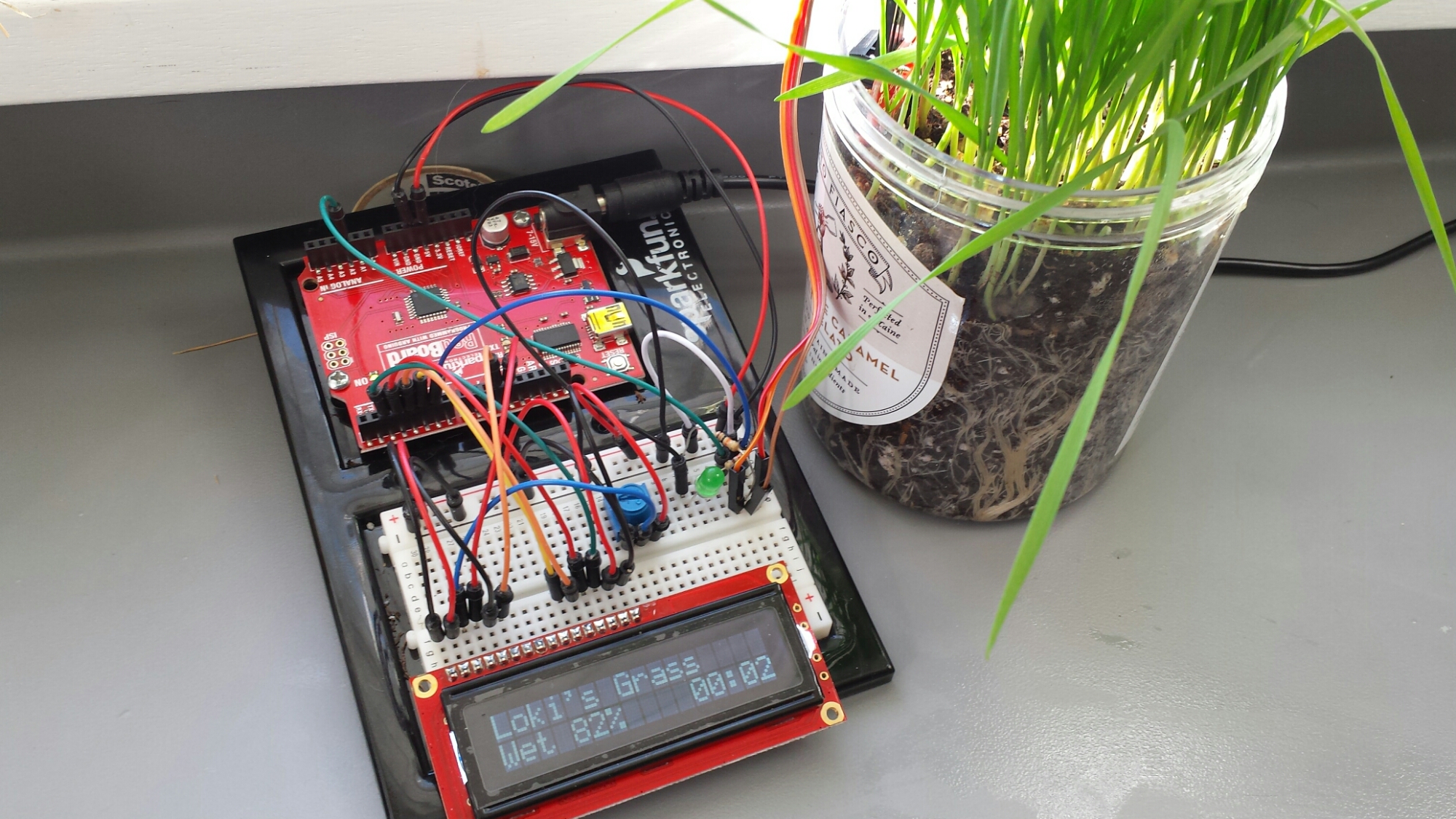
Last week I started a new project to measure soil moisture. The goal is to have WiFi connected IoT sensors in the West Garden reporting back to us here at the house, and at some point automate the drip irrigation system. For now I will use it to monitor Loki’s cat grass while I work out the kinks.
I have been surprised to find that measuring soil moisture is not a slam dunk. The devices you get at the garden shop do a good job but they use dissimilar metals to create a battery effect and cannot be left in the ground. Other sensors measure the resistance between two probes but again there is current flowing and there is corrosion going one.
This version uses an Arduino with an LCD screen and one of the ADC’s to measure resistance. The sensor is turned on for only 10 ms. each cycle to limit corrosion, and since the soil moisture changes slowly measuring once an hour is plenty.
But now I am running into a problem with the conductivity of the soil. This is a potting mix of peat and vermiculite. I start with it dry, it says 0%, I add a tiny bit of water and it jumps to 82%, soak it and it stays the same. Will do some more testing on that soon to get the range correct.
I did find one error, a resistor I left out in the ADC leg, opps, that would make funny readings for sure. Would not have been good on the Space Shuttle but those days are behind me.
Future versions will use Particle Photons with their easy on board WiFi and connectivity to the Cloud.
Drawing Your Own Circuits. September 10, 2015
Posted by dvgibson in Prototyping.add a comment
 Deep Ocean to Deep Space